
When Rejection Stings
and How Art Softens the Edges

Life Behind the Mic | Creative Crow Studios
I’ve been sitting with rejection a lot lately.
Not the big dramatic kind—just the quiet, unglamorous instances that accumulate like pebbles in your shoe. For me, it’s audition outcomes. Those polite, professional “we went another direction” emails that show up at random times of the day. I tell myself they’re not personal—they really aren’t. I sent the email asking for feedback…is it me? The reply was what I expected and I’m okay with that. My voice simply wasn’t the sound the author envisioned. I’ve been in this industry long enough to understand it deeply. (I knew that, but Bitsy kept whispering in my ear.) Living the creative lifestyle isn’t for the faint of heart.
But even so… it still stings.
Not like a wound, more like a bruise—tender when something brushes against it.
Rejection is universal. Whether you’re an artist, a teacher, a narrator, a baker, a gardener, or someone quietly trying something brave for the very first time… every one of us knows the ache of “not this time.”
And the mind is so quick to make meaning where none exists.
See? You weren’t good enough.
You should have known better.
Why did you even try?
And somewhere in the background, Miss Bitsy was already clearing her throat, preparing her Opinions with a capital O. Because nothing delights her quite like adding commentary to an emotional spiral.
She appeared the moment I opened the email—heels clicking, lipstick perfect, clipboard poised like she was about to conduct a performance review. She loves numbers, data points, patterns. And she’s convinced that two or three rejections in a row must surely mean something dreadful.
But that’s not how creativity—or life—works.
Rejection is not a verdict.
It’s not a measurement of worth.
It’s simply information.
It’s a closed door that redirects your feet toward another hallway. It’s a signal that this wasn’t your room—but your room still exists. And sometimes that room has a window with better light. Or a kettle already warm. Or a chair waiting for you that fits the curve of your back like it knows your story.
When I get an email that I didn’t land an audition, I feel the sting—but then I go to my art table.
Not to escape it.
To sit with it.
Because art holds emotions without trying to fix them.
It doesn’t ask you to perform.
It doesn’t tell you to be grateful when you’re disappointed.
It simply offers you space.
A brushstroke becomes a breath you didn’t know you needed.
A wash of color becomes a softening of tension in the chest.
Lines on paper begin to widen the tight tunnel of your thoughts.
Art is honest company.
And when I let myself create without expectation, the sting loosens its grip. Not because the rejection magically hurts less, but because I’ve given that feeling somewhere to go.
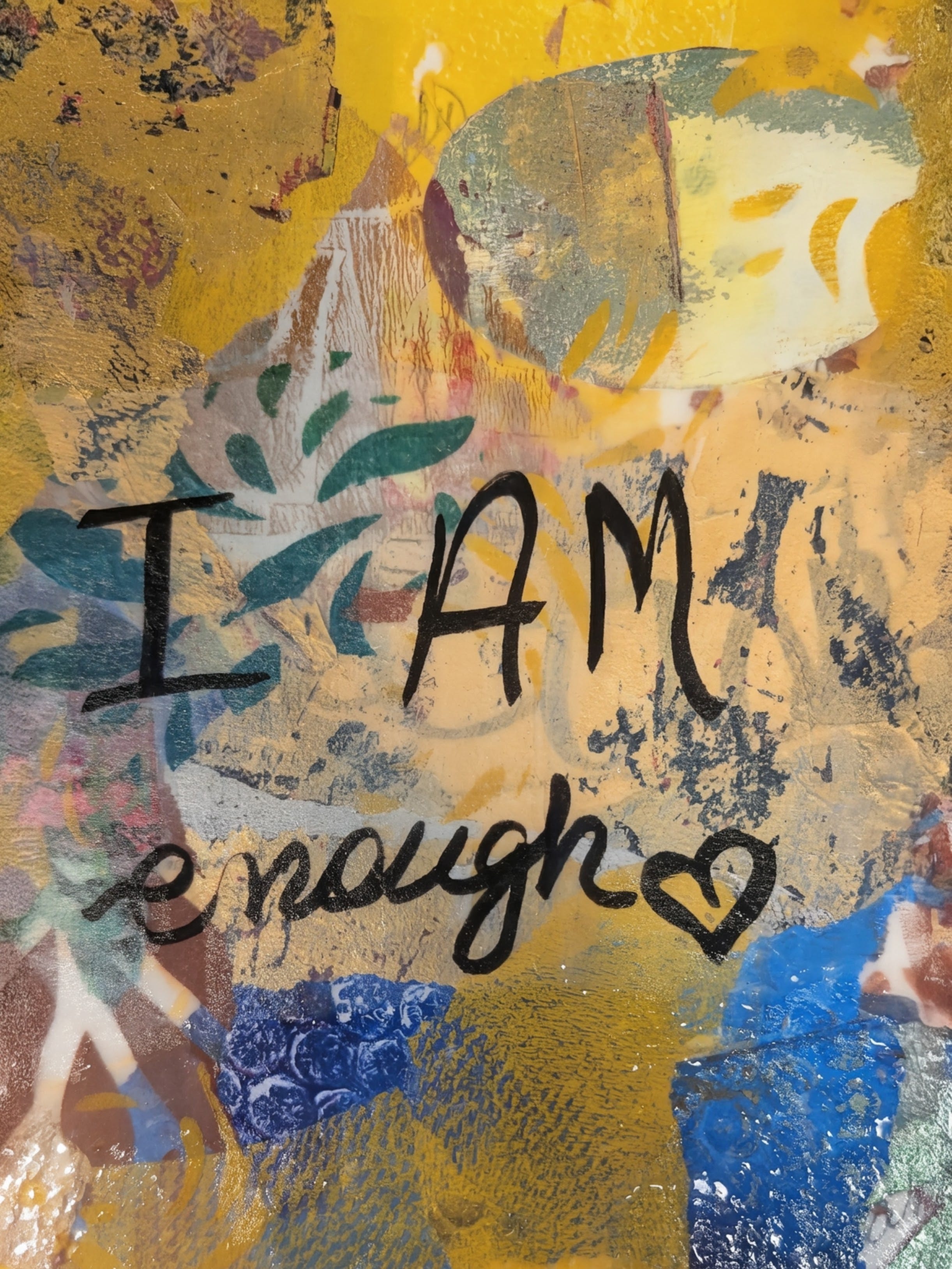
From the prompts below, I chose to make a collage out of scraps and rip-offs in the box of scraps I keep under my art desk. And yes, Miss Bitsy has a hard time with me hanging on to those scraps. She doesn’t quite understand yet that discarded things can come together and make something whole again. Different, but whole. Kind of like us. All the little moments…the little pieces of our lives…come together and make us a beautiful masterpiece.
Art Prompts for When Rejection Feels Heavy
1. Paint the Emotion, Not the Story
Grab a page and ask yourself:
If this feeling had a color, what would it be? A shape? A texture?
Don’t label anything. Don’t overthink it. Just let the sensation move through color and form.
When you’re done, write one sentence beneath it:
“This is how rejection feels today—no more, no less.”
2. Draw a Doorway
Sketch or collage a doorway—abstract, messy, or simple. Then journal around it:
What door closed for me?
What door might open next?
What do I hope is on the other side?
Rejection becomes movement, not an ending.
3. Make a Page of Possibilities
Create a collage of “what else could be true.” Tear paper, add color, write fragments, include images that feel open and possible.
Let the page become a map of alternative outcomes—ones where you grow, shift, or stumble into something even better.
4. Create a “Not This Time” Collection
Dedicate a sketchbook page to tiny marks, symbols, or color swatches—one for each rejection.
It becomes a visual record of resilience, not defeat.
5. The Three-Minute Reframe
Set a timer and spend three minutes filling a page with everything rejection does not mean about you.
I am still creative.
I am still growing.
I am still in the arena.
I am still needed.
I am still learning this craft.
This isn’t forced positivity—it’s reclaiming truth.
Miss Bitsy Sidebar: “Rejection? Oh Honey…”
“Well,” she said, tapping the paper with a dramatic sigh, “someone didn’t get the part. And before you ask, no, I’m not surprised. I told you not to get your hopes up. Expectations are where disappointment goes to do Pilates.”
She adjusted her cat-eye glasses, squinting at my face like she was searching for cracks.
“But look at you. Still standing. Still breathing. Still showing up at that art table like it’s your personal revival tent.” She sniffed, pretending to be unimpressed, but her voice softened around the edges. “Rejection is just a redirection, sweetheart. Even I know that. And I’ve made a career out of assuming the worst.”
She pats my cheek—gently, for once.
“Now go make something messy. Something that reminds you you’re alive and wildly capable. I’ll be over here timing your meltdown, which—shockingly—has yet to arrive.”
Miss Bitsy returns to her stool, muttering,
“Honestly, I don’t know who you think you are, handling things this well.”
And then, just under her breath:
“…but I’m secretly proud of you.”
So yes—rejection stings. It pokes the ego, kicks the shins, and occasionally sends us spiraling into philosophical questions like, “Should I just run away and open a goat sanctuary?” (Honestly… tempting.)
But then we pick up a brush, or a pen, or a microphone, and we realize:
Oh. Right. This is who I am.
Meanwhile, Miss Bitsy is over in the corner pretending she’s not invested, filing her nails and sipping lukewarm tea.
“Oh look,” she says dramatically, “another ‘no.’ Should I alert the press? Prepare the fainting couch? Order us matching mourning veils?”
But the second she sees you sketch a doorway or splash color on a page, her posture changes. She lowers her glasses, squints, and mutters:
“Hmm. Well. That’s… oddly impressive. Rude of you, really, to bounce back like that. I was ready for theatrics.”
And then, because she can’t help herself, she adds:
“Fine. Fine. Keep going. I suppose if Beyoncé survived criticism, you’ll survive this.”
Rejection, it turns out, is not the villain of the story.
It’s just an inconvenient side character with bad timing.
And you—you’re the one who turns even the messiest plot twists into art.
Keep creating.
Miss Bitsy and I will be right here, cheering you on…
even if she pretends it’s an aerobics class for her eyebrows.
Creating, narrating, and navigating the messy middle—
Jenn